

Boost Employee Wellness Through a Clean Environment: How Workplace Cleanliness Enhances Health and Productivity
A truly clean workplace is more than shiny floors and neat desks — it’s a coordinated approach to surface sanitation, indoor air quality, and clutter control that lowers allergens and pathogens while making staff more comfortable. Professional cleaning that targets surfaces, carpets, HVAC-adjacent dust, and occasional fogging can cut sick days and create conditions that help people focus, think clearly, and work together. This guide walks through the main health advantages of a clean workplace, the psychological link between tidy spaces and better performance, which professional services drive measurable wellness gains, and simple ways to quantify return on investment. You’ll get practical, evidence-backed steps — surface disinfection, deep fiber cleaning, fogging, and dust control near vents — plus scheduling and measurement tips facility managers can use right away to support a healthier workplace and reduce absenteeism.
What Are the Key Health Benefits of Maintaining a Clean Workplace?
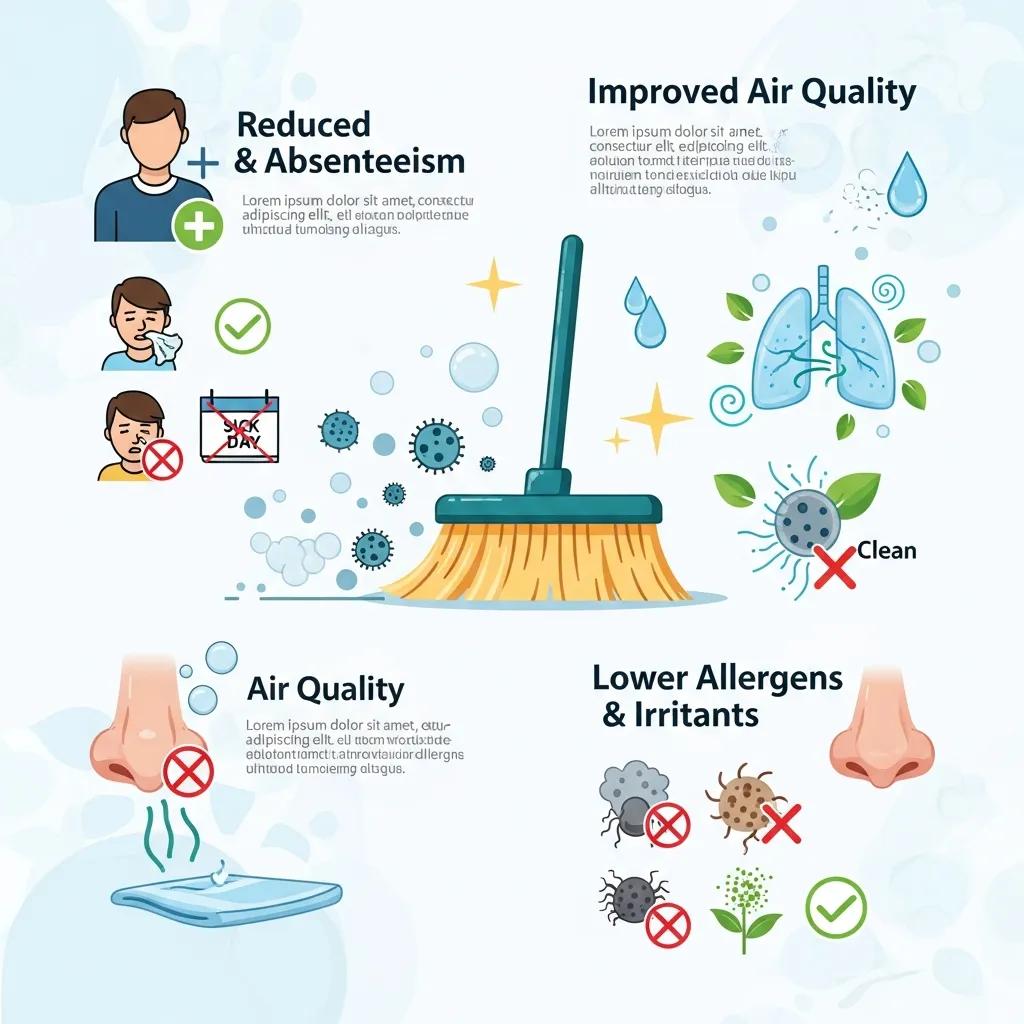
Keeping a workplace clean reduces how often infections spread, lowers allergen levels, and helps breathing by removing places where dirt and microbes build up. Regularly sanitizing high-touch surfaces and scheduling targeted services like commercial carpet cleaning and fogging lower the number of live microbes on commonly handled items and in porous materials — and that typically means fewer people showing symptoms. Cleaner spaces also limit exposure to dust mites, pollen, and embedded carpet particulates; reducing those reservoirs often translates into fewer allergy flare-ups and interruptions to work. Those physical health gains set the stage for better mental wellbeing and higher productivity.
Below is a clear summary of the primary health benefits and the outcomes you can expect.
- Less spread of common respiratory and gastrointestinal illnesses through surface disinfection and focused high-touch cleaning.
- Lower airborne particulates and allergens thanks to carpet cleaning, disciplined dust control, and care around HVAC intakes.
- Fewer and shorter sick leaves by combining routine sanitation with periodic deep-cleaning.
- Reduced allergy incidents and greater respiratory comfort during high-pollen seasons or winter months.
Putting services side-by-side clarifies which treatments most directly improve each health attribute and what results are reasonable to expect.
Different cleaning methods affect health by removing contaminants from the places they hide and spread.
| Service Type | Health Attribute Targeted | Expected Outcome |
|---|---|---|
| Fogging (disinfectant mist) | Pathogen reduction on surfaces and in the air | Fewer outbreak-related sick days; rooms ready for use sooner after treatment |
| Commercial carpet cleaning | Removal of embedded allergens and particulates from fibers | Lower allergy symptoms and measurable IAQ improvements |
| Regular janitorial/high-touch disinfection | High-touch pathogen reservoirs (doorknobs, shared equipment) | Ongoing reduction in day-to-day transmission |
Used together, these services create layered protection that tackles both short-term pathogen risk and longer-term allergen buildup. That’s why planned combinations and schedules beat one-off cleanings.
How Does Office Cleaning Reduce Germs and Workplace Illnesses?
Office cleaning lowers germs and illness by removing or inactivating pathogens where they collect and spread. Effective protocols concentrate on high-touch items — keyboards, light switches, break-room surfaces, phone handsets — and use EPA-registered disinfectants with proper dwell times to inactivate viruses and bacteria. Frequency matters: daily cleaning of shared spaces plus periodic deep-cleaning stops reservoirs from returning between visits. In practice, pairing daily janitorial disinfection with targeted interventions during higher-risk periods produces measurable drops in symptomatic illness and short-term absenteeism.
High-touch protocols should be clear, repeatable, and documented so results stay reliable. That naturally leads into how air-quality-focused services further reduce risk.
In What Ways Does Commercial Cleaning Improve Indoor Air Quality?
Commercial cleaning improves indoor air quality by removing dust, fibers, and trapped allergens that worsen IAQ and by lowering airborne microbial loads through targeted sanitation. Deep-cleaning carpets and upholstery pulls out particulate matter lodged in fibers, while disciplined dust-control cuts down on particles that re-suspend into breathing zones. Many professional programs coordinate with HVAC maintenance — filter checks and dust removal near vents — to limit contaminant circulation. Fogging and room-level sanitization, when paired with proper ventilation, can temporarily reduce airborne pathogen concentrations and create measurable IAQ gains that help respiratory health and cognitive performance.
Here’s a quick example linking a common service to an IAQ improvement.
| Intervention | Typical Mechanism | IAQ Benefit |
|---|---|---|
| Carpet deep-cleaning | Extraction of trapped particulates and allergens | Lower airborne particle counts and fewer allergy triggers |
Coordinating surface care, floor maintenance, and HVAC-adjacent work multiplies air-quality benefits and supports facility-wide wellness.
Workplace Cleanliness: Enhancing Employee Wellness and Productivity
A clean workspace supports mental wellbeing and productivity by lowering cognitive load, easing stress, and signaling that the organization cares. When clutter and visual distractions are reduced, employees spend less mental energy managing their environment and more on core tasks — leading to faster task completion and better creative thinking. Visible, consistent cleaning practices also boost morale and trust in leadership, which lowers turnover intention and increases discretionary effort. Those psychological effects explain why cleanliness programs deliver both immediate comfort and longer-term productivity gains.
Here are three quick ways a cleaner environment translates into better performance.
- Mood: Well-maintained spaces reduce stress and lift overall morale.
- Focus: Fewer distractions and less odor or air complaints let employees sustain attention longer.
- Creativity: An organized environment frees mental space for ideation and teamwork.
Because these benefits depend on consistent action, the next section looks at the services that turn wellness goals into operational reality.
What Is the Psychological Impact of Office Hygiene on Staff Morale and Focus?
Office hygiene affects morale and focus by giving visible signals that leadership values staff wellbeing and by removing small environmental annoyances that interrupt attention. Employees who work in places with steady cleaning protocols report feeling more supported and are more willing to join collaborative efforts. Regular removal of clutter and a fresh, ventilated atmosphere reduce background stressors that produce micro-interruptions. On the ground, this looks like smoother meetings, fewer task switches, and higher self-reported concentration during peak hours.
Because perception shapes behavior, collectible feedback — short cleanliness satisfaction surveys, for example — helps connect psychological outcomes to cleaning choices.
How Does Reducing Clutter and Stress Through Cleaning Boost Creativity and Efficiency?
Cutting clutter and stress through cleaning boosts creativity and efficiency by removing competing visual stimuli and by creating predictable conditions that encourage risk-taking and experimentation. Cognitive-load research shows that excess clutter forces the brain to manage surroundings instead of solving problems. Practical steps — daily desk-clear policies, weekly resets of communal areas, and clear storage solutions — reduce that burden. Over time, these routines shorten the time it takes to refocus after interruptions and build a sense of control that supports cross-team collaboration and faster idea development.
Consistent decluttering and simple routines reduce task-switching and increase time-on-task, forming a foundation for measurable productivity gains and for targeted professional services described below.
Which Professional Cleaning Services Support Employee Wellness in the Workplace?
McCoy Maintenance is a family-owned company established in 1984. Led by Certified Master Cleaner David McCoy, we back our work with a 100% satisfaction guarantee and offer customized cleaning plans delivered by trained, background-checked staff. Eco-friendly options are available. Our services include Office Cleaning, Janitorial Services, Commercial Cleaning, Commercial and Residential Carpet Cleaning, Fogging, Floor Maintenance, Construction Cleaning, and Upholstery Cleaning. We serve Macomb County, Oakland County, and Metro Detroit.
Professional cleaning services support employee wellness by combining daily upkeep, scheduled deep-cleaning of porous materials, and targeted outbreak interventions to form a layered defense against illness and allergens. Core offerings include daily office cleaning and janitorial services to control high-touch spread, commercial carpet cleaning to remove embedded allergens, and fogging for quick pathogen reduction during elevated-risk periods. Tailored plans — for example, more frequent disinfection in medical offices or focused workstation care in corporate environments — help minimize disruption while maximizing wellness outcomes.
Below are the common service categories and the direct wellness benefits each delivers.
- Office cleaning and janitorial services: Daily sanitation of high-touch surfaces and reliable waste management to cut routine transmission.
- Commercial carpet and upholstery cleaning: Deep extraction to reduce allergens and particulate reservoirs that harm air quality.
- Fogging and deep sanitization: Rapid room-level disinfection for outbreak control and post-event cleanup.
The table below shows recommended frequencies and the primary wellness payoff, so decision-makers can pick plans that fit operations.
| Service | Typical Frequency | Primary Wellness Benefit |
|---|---|---|
| Daily janitorial/office cleaning | Daily | Continuous control of high-touch pathogens and visibly clean surfaces |
| Commercial carpet cleaning | Quarterly to biannual | Marked reduction in allergens and particulates trapped in floor coverings |
| Fogging / deep sanitization | As-needed / during outbreaks | Fast reduction of pathogen load for acute risk situations |
Frequency matters: steady delivery maintains a protective baseline while scheduled deep services remove longer-term reservoirs.
How Do Tailored Office Cleaning and Janitorial Services Promote a Healthy Environment?
Tailored office cleaning and janitorial services promote health by matching scope, timing, and cleaning agents to a facility’s function, occupancy, and risk profile. Custom plans include clear high-touch point lists, offer eco-friendly choices when requested, and schedule work to reduce disruption. Our background-checked, trained teams follow standardized protocols and use checklists and maintenance logs for quality assurance. Customization also lets us adapt by industry — more frequent disinfection in healthcare settings or concentrated attention to shared spaces in open offices — focusing effort where it matters most for wellness.
These tailored routines support ongoing wellness improvements and work alongside deeper interventions like carpet cleaning and fogging.
What Role Do Specialized Services Like Commercial Carpet Cleaning and Fogging Play in Employee Health?
Specialized services such as commercial carpet cleaning and fogging address reservoirs and transmission paths that daily cleaning can’t fully control. Deep-cleaning carpets and upholstery pulls out embedded allergens, dust, and organic debris that can re-suspend and aggravate respiratory symptoms. Fogging applies a fine disinfectant mist to surfaces and airspace to rapidly lower pathogen counts — useful during outbreaks or after large gatherings. Cadence depends on use: heavy-traffic carpets may need quarterly to biannual treatment, while fogging is used as an as-needed escalation. When performed by trained operators, both methods produce measurable drops in allergen counts and viable microbes.
Layering routine janitorial work with scheduled specialized services builds a strong defense against both chronic and acute environmental risks.
Why Choose McCoy Maintenance for Enhancing Employee Wellness Through Clean Environments?
Choosing a cleaning partner that combines operational reliability with wellness outcomes reduces management overhead and builds staff confidence in workplace safety. McCoy Maintenance offers local, experienced teams and a service menu designed to tackle everyday hygiene and deeper allergen or pathogen reservoirs — a practical fit for businesses across Macomb County, Oakland County, and Metro Detroit. Our focus on customized plans and background-checked staff supports consistent execution and accountability, while eco-friendly options limit chemical exposure for sensitive team members. Local presence means faster response for urgent work and better alignment with your business schedule.
Here are the company strengths and how they translate into wellness benefits for clients.
- Certified Master Cleaner leadership: Oversight that keeps procedures consistent and reliable.
- 100% satisfaction guarantee: Accountability that drives measurable outcomes.
- Background-checked, trained staff: Safer access to sites and dependable, professional execution.
The table below highlights how local experience and clear guarantees reduce friction when starting or scaling a wellness-focused cleaning program.
| Company Strength | How It Supports Wellness | Regional Benefit |
|---|---|---|
| Master Cleaner oversight | Ensures procedural rigor and quality control | Faster onboarding and consistent results for local sites |
| Customized solutions | Matches frequency and services to facility needs | Less operational disruption and better fit with schedules |
| Eco-friendly options | Reduces chemical exposure for sensitive employees | Aligns with workplace health and sustainability goals |
These trust signals make it easier for organizations to pilot wellness-driven cleaning programs and demonstrate real improvements in attendance, IAQ, and staff satisfaction.
What Unique Expertise and Customized Solutions Does McCoy Maintenance Offer?
McCoy Maintenance brings certified protocol leadership and a service menu built for customization. Master Cleaner-led protocols guide disinfectant choices, cleaning methods, and quality checks so standards remain consistent. Custom plans target the highest-impact areas for each workplace, reducing risk and improving outcomes. Background-checked staff and documented workflows lower liability and support repeatable results. Eco-friendly options provide alternatives for spaces with chemical sensitivities. Mapping these capabilities to wellness goals — fewer pathogen reservoirs, lower allergen loads, and reliable cleaning rhythms — helps facility managers pick services that deliver measurable change.
Local experience matters for pilots and iterative improvements, and our regional focus supports quick adjustments and site-specific optimization.
How Does Local Service in Macomb, Oakland, and Metro Detroit Benefit Businesses?
Local service benefits businesses through faster responses, familiarity with common regional facility types, and simpler coordination for pilot programs and site assessments. Proximity allows flexible scheduling for urgent remediation like post-event fogging, and local teams often have nearby references and relevant case experience. This closeness also simplifies ongoing monitoring and follow-up visits, supporting sustained wellness outcomes and quicker plan adjustments. For organizations measuring impact, a regional partner reduces logistical friction for before/after testing and tailored reporting.
Because pilots depend on rapid feedback loops, working with a local provider speeds measurement and optimization.
How Can Businesses Measure the Impact of Cleanliness on Employee Wellness and Productivity?
Measuring the impact of cleaning on wellness and productivity uses a focused set of KPIs, short pilots, and steady data collection that link environmental changes to health and performance. Core metrics include sick days per month, employee-reported wellbeing and perceived cleanliness scores, and basic IAQ indicators like particulate counts or CO2 trends when available. Run a pre/post pilot with baseline collection, an intervention period, and follow-up to create credible comparisons. If you want local evidence, engage a partner to run a short pilot with a defined measurement cadence to quantify ROI and operational impact.
Use the short metric list and mini-template below to structure a pilot and capture results effectively.
- Sick days per month: Track aggregate and department-level sick-day counts for three months before and after the intervention.
- Employee cleanliness perception: Collect brief weekly surveys to measure perceived hygiene and comfort.
- IAQ and environmental logs: Monitor particulate counts or maintenance logs to spot changes after cleaning interventions.
The KPI table below shows measurement methods and the expected improvements after professional cleaning.
| Metric | How to Measure | Expected Change After Professional Cleaning |
|---|---|---|
| Sick days per month | HR attendance records, anonymized by department | 10-30% reduction over three months in many settings |
| Employee-reported wellbeing | Short pulse surveys (weekly/biweekly) | Higher perceived cleanliness and comfort scores |
| Airborne particulates (PM2.5/PM10) | Portable IAQ monitors or third-party testing | Noticeable decreases after carpet deep-cleaning and disciplined dust control |
Running a structured pilot with these metrics produces actionable evidence of cleaning-driven wellness gains and informs decisions about scaling services.
What Metrics Demonstrate Reduced Sick Days and Improved Staff Well-Being?
Metrics that show fewer sick days and better staff wellbeing include aggregate absenteeism rates, short pulse survey scores on perceived cleanliness and health, and simple productivity proxies like task turnover or meeting attendance. Typical cadence uses a 30–90 day baseline, a 30–90 day implementation window, and a post-intervention analysis period to factor in seasonality. Examples include percent change in sick days per 100 employees or average survey score lifts; normalizing by headcount makes comparisons across departments straightforward. These practical, lightweight metrics tie directly to operational choices about cleaning scope and frequency.
Providing clear reporting formats and a regular cadence builds stakeholder confidence and supports iterative improvements to cleaning plans.
How Do Case Studies and Statistics Support the ROI of Professional Cleaning Services?
Case studies and statistics help show ROI by converting environmental interventions into business outcomes — fewer sick days, higher productivity, and better retention — using before/after data and anonymized client examples. A strong case study spells out the initial problem, the intervention (services and frequency), quantifiable results (KPI changes), and notes on cost and disruption. Industry benchmarks — such as reductions in absenteeism after focused cleaning — offer helpful context. For localized proof, ask your cleaning partner for pilot programs and anonymized client summaries to replicate successful approaches in similar facilities.
| Case Study Element | Purpose | Example Outcome |
|---|---|---|
| Challenge | Define the baseline problem (for example, frequent allergy complaints) | Describe specific symptoms and operational costs |
| Intervention | Specify services and cadence (for example, quarterly carpet cleaning + daily disinfection) | Outline duration and scope of the work |
| Result | Quantify KPI changes (sick days, survey scores) | Report percent reductions or score improvements |
This structure helps facility managers build a clear business case for continuing wellness-focused cleaning investments and present measurable ROI to stakeholders.
Frequently Asked Questions
What are the long-term benefits of maintaining a clean workplace?
Long-term benefits include better employee retention, higher job satisfaction, and greater productivity. A consistently clean environment builds pride and ownership among staff, which can lower turnover. It also reduces illness risk, leading to fewer sick days and a more engaged workforce. Over time, these effects strengthen organizational culture and can improve the bottom line through higher efficiency and less absenteeism.
How can businesses effectively implement a cleaning schedule?
Start by assessing your space, occupancy, and high-traffic zones. Create a clear checklist that breaks tasks into daily, weekly, and monthly items. Involve employees by asking for feedback on trouble spots, and review the schedule regularly to adjust based on results and changing needs. Consistency, communication, and simple documentation are the keys to a working schedule.
What role does employee feedback play in maintaining workplace cleanliness?
Employee feedback is essential — it highlights areas that need extra attention and reveals how cleaning impacts comfort and productivity. Short surveys or informal check-ins help you prioritize resources and demonstrate responsiveness. Acting on feedback builds a collaborative culture and keeps cleaning efforts aligned with real needs.
How can businesses quantify the ROI of cleanliness initiatives?
Track KPIs such as reduced sick days, improved productivity measures, and employee satisfaction scores. Run short pre/post pilots to show change over time and use HR data and pulse surveys to quantify results. Partnering with a cleaning provider to collect and analyze data makes the business case clearer and helps justify ongoing investment.
What are some eco-friendly cleaning options available for businesses?
Eco-friendly options include biodegradable cleaners, non-toxic disinfectants, microfiber tools, and green-certified equipment. Many providers offer customizable green programs that reduce chemical exposure for sensitive staff. Pairing these choices with recycling and waste-reduction practices further supports sustainability goals while protecting employee health.
How does workplace cleanliness affect employee collaboration?
Clean, organized spaces encourage collaboration by removing distractions and creating an inviting atmosphere. When employees see that leadership cares about the environment they work in, they’re more likely to engage with colleagues and participate in group activities. The result is better communication, increased creativity, and stronger team performance.
Conclusion
Keeping your workplace clean is a practical investment in employee health, productivity, and morale. Thoughtful, consistent cleaning reduces absenteeism, supports a positive culture, and yields measurable benefits. Partnering with a professional provider that offers tailored plans, trained staff, and eco-friendly options makes it easier to protect your team and your bottom line. Learn how a customized cleaning program can transform your workplace and keep your people healthier and more productive.