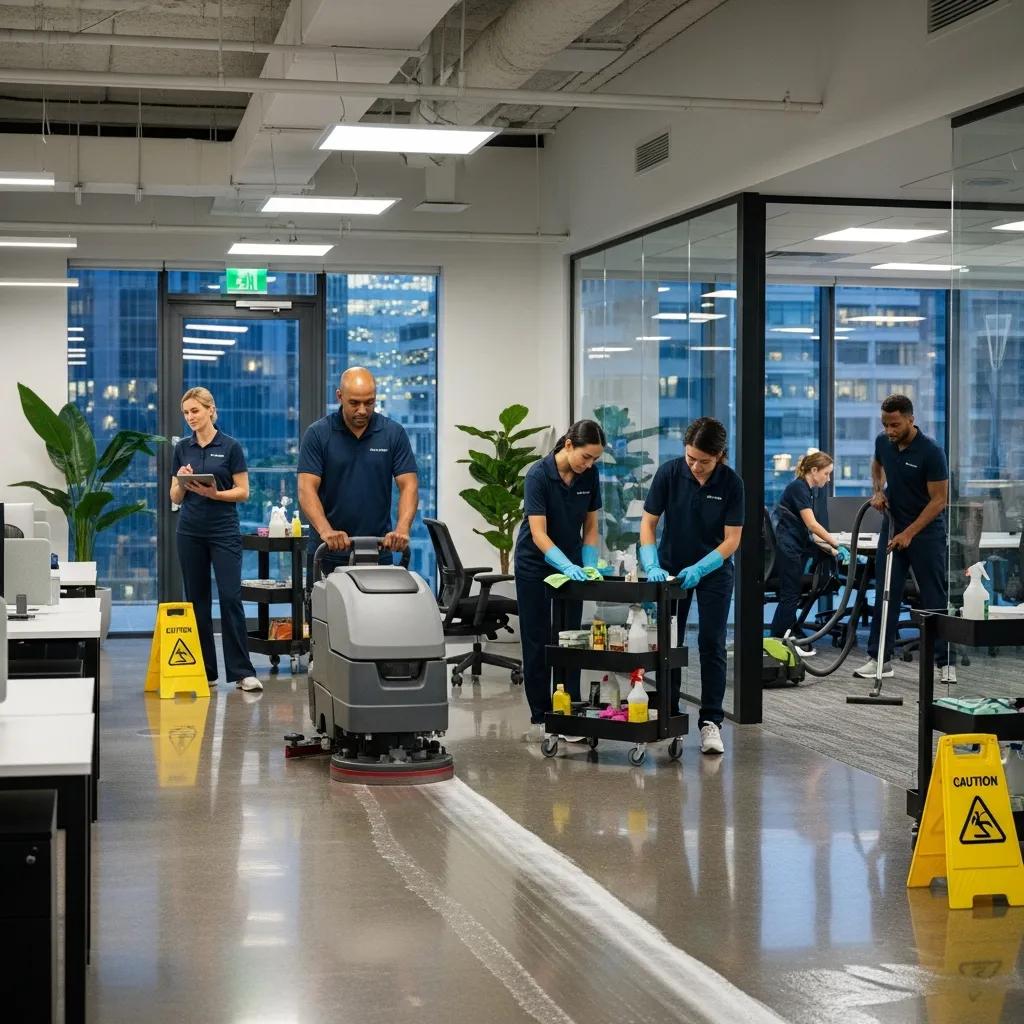
Your Complete Guide to Commercial Cleaning Costs — Rates, Pricing Models, and Value
Use this guide to understand how commercial cleaning prices are set, the common pricing approaches you’ll see, and practical benchmarks to build a realistic cleaning budget. We focus on Metro Detroit conditions, including Macomb County, Oakland County, and Wayne County, and the real factors that move prices — facility size and layout, visit frequency, labor and supply costs, and specialty jobs like carpet care or fogging. You’ll learn how to weigh hourly rates against per-square-foot fees, read fixed-rate contract terms, and compare proposals so you can balance cost and service. We map the main cost drivers, show Metro Detroit per-square-foot ranges, explain specialty-service pricing, and share tips to get the most value from a provider. Helpful tables and checklists make comparison fast, and local examples show how these ideas work on the ground.
McCoy Maintenance is a family-owned commercial cleaning company and floor-care company founded in 1984 and based in Eastpointe, MI. We created this guide to help local businesses in Macomb County, Oakland County, and Wayne County estimate cleaning budgets and compare proposals. Our services include office cleaning, janitorial contracts, commercial carpet cleaning, upholstery cleaning, floor maintenance, fogging, and construction cleanup. We build custom plans and stand behind our work with a 100% satisfaction guarantee — that local perspective informs the Metro Detroit examples and keeps the guide practical and objective.
What factors most affect commercial cleaning costs?
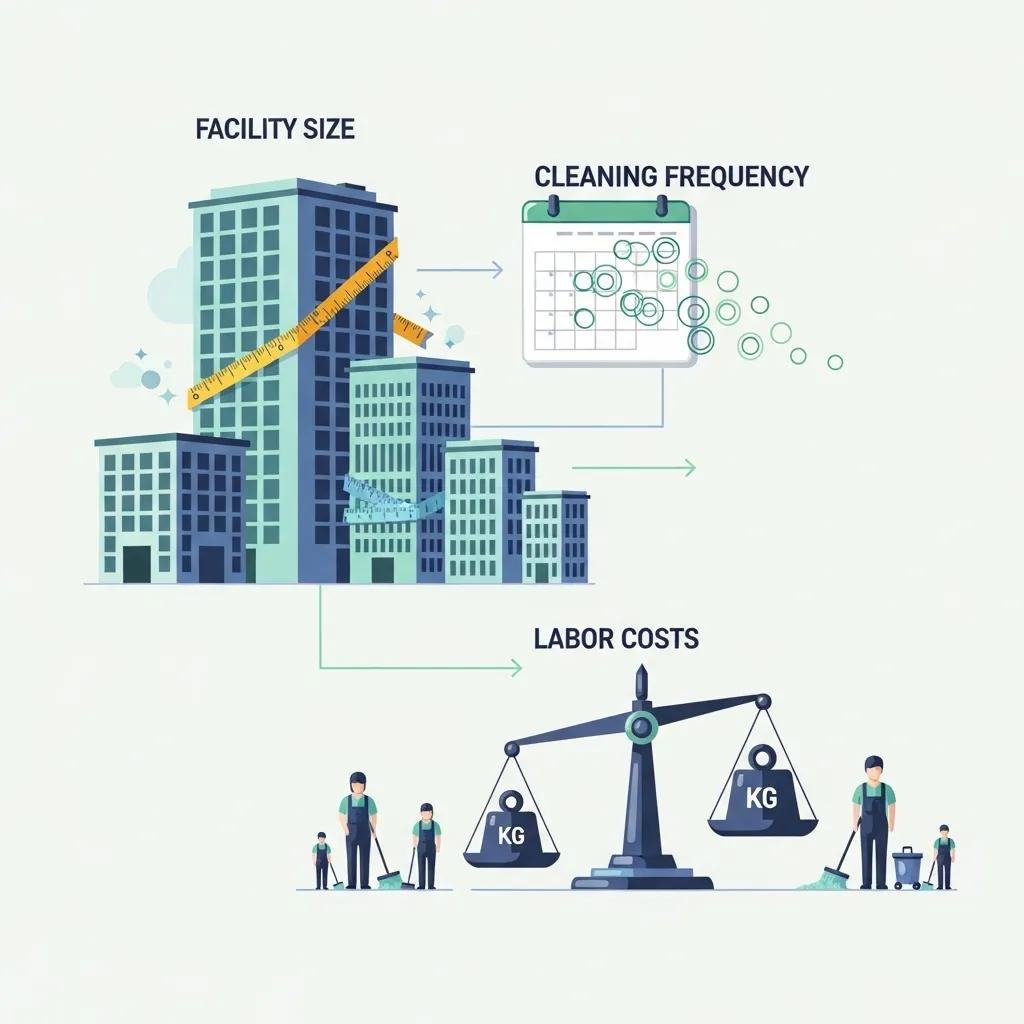
Commercial cleaning price quotes come from a few predictable inputs: size and layout of the space, how often it’s cleaned, the facility type, labor and supply costs, and local overhead. Each factor changes the time or materials needed, which directly affects quotes and contract pricing. Knowing how these pieces fit together helps you build accurate budgets and avoid surprises when comparing bids. The table below highlights typical impact levels for the major drivers so you can prioritize what matters most before we look at pricing models and local benchmarks.
| Factor | What it Controls | Typical Impact on Cost |
|---|---|---|
| Facility size & layout | How long each visit takes and what equipment is needed | High |
| Cleaning frequency | Staff scheduling and supply use | Medium‑High |
| Facility type (medical, retail) | Regulatory needs and special tasks | High |
| Labor rates & staffing | Hourly charges and overtime exposure | High |
| Supplies & equipment | Consumables and specialty tools | Medium |
| Geographic overhead & insurance | Travel time and local wage/insurance differences | Medium |
This table shows which attributes to check first when you request a quote or compare vendors. The next sections explain exactly how size and frequency change pricing so you can convert those factors into dollars.
How does facility size affect cleaning prices?
Square footage is a primary input because it sets the baseline area to clean and often determines the per-square-foot rate commercial cleaning companies use. Large, open spaces usually clean faster per square foot than many small rooms because crews spend less time moving between offices and dealing with obstacles. For example, a 5,000 sq ft office at $0.10–$0.25 per sq ft equals roughly $500–$1,250 per visit, though complex layouts or heavy-traffic areas push that higher. Size also guides equipment choices — ride-on scrubbers for big facilities versus handheld tools for small ones — and that changes capital and pricing decisions.
Layout and access affect frequency planning, too. Irregular or multi‑floor buildings often take more staff time per visit and may benefit from more frequent, shorter visits to control labor spikes and keep service consistent.
What role does cleaning frequency play in cost?
Frequency spreads fixed setup costs and changes how intense each visit must be, creating trade-offs in per-visit and monthly pricing. Regular daily or several-times‑weekly service usually lowers the effective per-square-foot or per-visit price because crews get familiar with the site, supply use stabilizes, and buying in bulk becomes possible. One‑time deep cleans and occasional specialty jobs carry higher per-visit rates because of setup, mobilization, and heavier labor or equipment needs. Frequency also affects staffing: steady schedules reduce overtime risk, while infrequent visits may require larger crews or more time on site.
Knowing these effects helps you model scenarios — daily vs. three-times-weekly vs. monthly — and decide whether lower unit costs from more frequent service are worth the extra visits. Next we’ll compare the common pricing models you’ll see in proposals.
Which pricing models for commercial cleaning should you know?
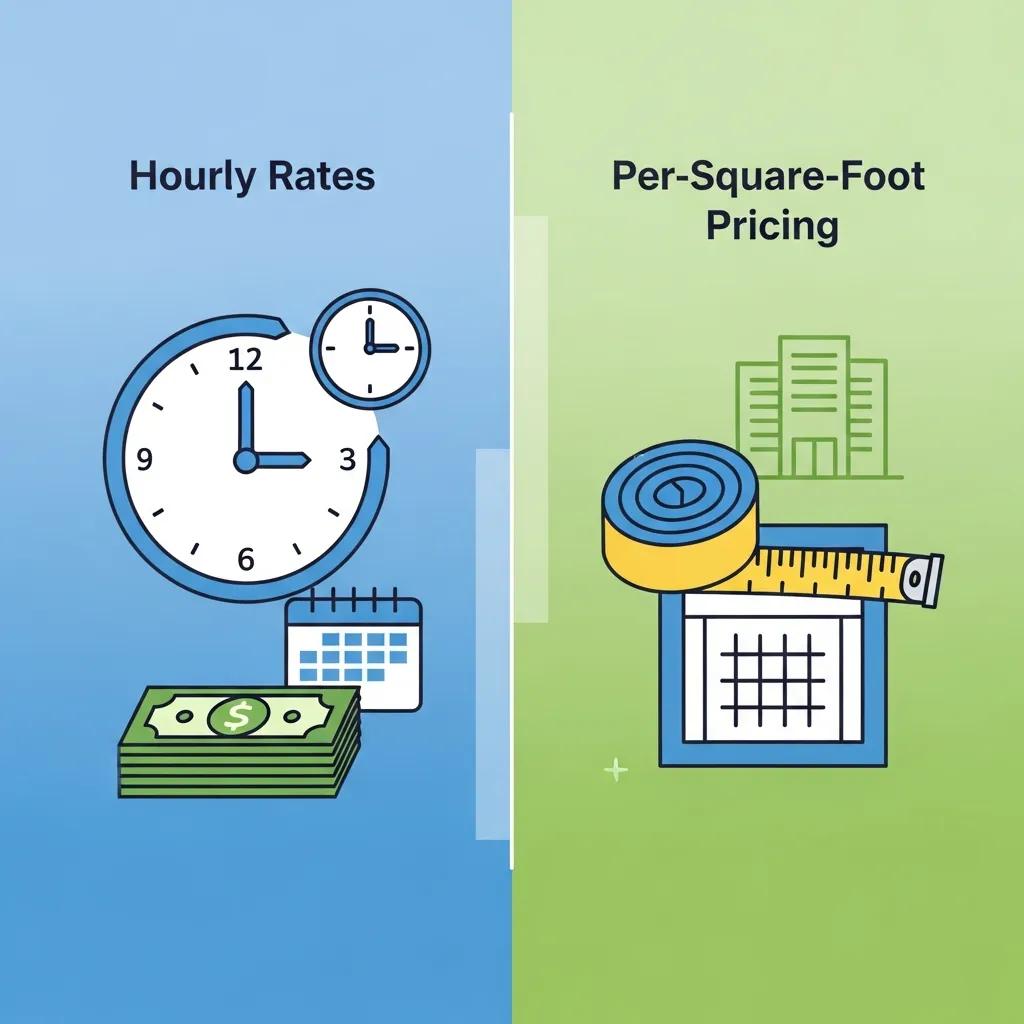
Most commercial cleaning companies price work with one of four approaches: hourly rates, per‑square‑foot pricing, fixed‑rate contracts, or custom quotes. Each model handles predictability, fairness, and hidden costs differently. Understanding the pros and cons helps you pick the best approach for your building, budgeting needs, and risk tolerance. The table below summarizes the models to help you decide.
| Pricing Model | Typical Use Case | Pros | Cons | When to Choose |
|---|---|---|---|---|
| Hourly | Variable scopes, short-term jobs | Flexible and simple when scope is unknown | Harder to budget; can invite inefficiency | Small or irregular jobs |
| Per-square-foot | Uniform office layouts | Predictable and easy to compare | Less accurate for complex or room-heavy layouts | Open-plan offices |
| Fixed-rate contract | Long-term recurring service | Budget certainty and volume discounts | Rigid if your needs change | Stable sites with steady scope |
| Custom quote | Specialized needs (medical, construction) | Tailored scope; includes necessary extras | Requires detailed scoping and review | Unique or high‑compliance sites |
Use this comparison to match model to your situation. The following sections dig into hourly vs. per‑square‑foot math and explain when fixed contracts or custom quotes make sense.
How do hourly rates compare to per-square-foot pricing?
Hourly billing charges for actual time on site and is useful when tasks change or the scope is still unknown. The math is simple: estimated hours × hourly rate, plus supplies if they’re extra. Per‑square‑foot pricing multiplies area by a unit rate and fits predictable, consistent spaces. For example, a crew charging $35/hour that spends 8 hours on a visit charges $280; a 2,000 sq ft office at $0.12/sq ft costs $240 per visit. Per‑square‑foot pricing is more predictable, but it can over- or under-value work on irregular sites.
Pick the method that matches how predictable your layout and tasks are: hourly for flexibility, per‑square‑foot for simple budgeting in standard office footprints. Next we’ll cover why fixed contracts and custom quotes can be better for long-term planning.
What are the benefits of fixed-rate contracts and custom quotes?
Fixed-rate contracts lock in price for a defined scope and frequency, giving budget certainty and often volume or term discounts that lower unit costs. A good contract includes a Service Level Agreement (SLA), a clear list of inclusions and exclusions, termination terms, and scheduled frequencies to avoid surprises. Custom quotes adapt to special needs — medical compliance, post-construction cleaning debris, or specialty floor work — so the right equipment, chemicals, and insurance are included.
Fixed rates reduce cost volatility but can be inflexible if needs change. Custom quotes improve accuracy but need careful scoping and review. When you evaluate proposals, watch SLA remedies, escalation clauses, and how add-ons like carpet cleaning or fogging are billed so you avoid hidden fees. Next, we’ll anchor budgeting with local Metro Detroit per‑square‑foot benchmarks.
What are average commercial cleaning rates per square foot in Metro Detroit?
Local benchmarks give a starting point to sanity‑check vendor quotes. Metro Detroit rates across Macomb County, Oakland County, and Wayne County vary by county, building type, frequency, and compliance requirements, but short-range per‑square‑foot figures offer useful ballpark estimates. Use the table below to compare common service types and remember: after-hours work, heavy soil, or added compliance push rates to the high end.
| Service Type | Typical Range (USD/sq ft) | Frequency/Conditions | Notes |
|---|---|---|---|
| Standard office cleaning | $0.08 – $0.25 | Daily/weekly | Varies with layout and frequency |
| Janitorial contract (recurring) | $0.10 – $0.30 | Monthly billing | May include routine supplies |
| Commercial carpet cleaning | $0.20 – $0.60 | Periodic deep clean | Traffic and stain work raise cost |
| Construction/post-construction | $0.15 – $0.50+ | One-time; debris removal | Depends heavily on debris and hazards |
Use these ranges to build realistic budgets. The next subsections break down typical office and janitorial services contract costs so you know what to expect for common scenarios.
What are typical office cleaning service costs?
In Metro Detroit, particularly in cities like Royal Oak, Troy, and Sterling Heights, standard office cleaning is usually priced per square foot or per visit depending on frequency and what’s included. Low-scope weekly visits for small offices can start around $0.08/sq ft, while daily full-service programs with restroom care and trash removal commonly fall between $0.20 and $0.25/sq ft. Offices with frequent touchpoints, kitchenettes, or special breakroom tasks will be higher because of added labor and supply use. When you budget for office janitorial services, convert per-visit costs into monthly totals by multiplying visits per month and confirm whether consumables and paper goods are included.
Knowing these ranges helps you understand how janitorial contracts are usually structured and billed.
How much do janitorial service contracts usually cost?
Janitorial services contracts are often quoted as a monthly fee or a per‑square‑foot rate tied to a clear scope and frequency. Monthly costs vary widely: small sites can be low hundreds, mid‑size offices often run in the low thousands, and larger facilities scale up from there. Standard inclusions are restroom cleaning, trash removal, vacuuming, and dusting. Extras often billed separately include window washing, floor stripping/waxing, and specialized carpet treatments. Longer contracts and higher-frequency schedules generally deliver lower per-visit or per‑sq‑ft rates, but watch for auto-renewal and escalation clauses that can change costs over time.
Careful contract review prevents unexpected add-ons. The next section explains how carpet cleaning and specialty services like fogging affect budgets.
How do carpet cleaning and specialty services affect your budget?
Specialty services — commercial carpet cleaning, fogging/disinfection, and post-construction cleaning — are scoped and priced separately from routine janitorial work and can meaningfully change annual budgets. They often use different equipment, require longer site times, and need special chemicals or safety steps that increase cost. Bundling these services with regular contracts or scheduling them during off-hours typically brings down per‑service pricing. Below we explain carpet cleaning pricing and how fogging and construction cleanup get priced so you can plan for episodic or project work.
At McCoy Maintenance we handle both commercial and residential carpet cleaning and schedule specialty work to minimize disruption, showing how bundling and smart scheduling can lower lifecycle floor-care costs.
What are the costs for commercial carpet cleaning?
Carpet cleaning is usually priced per square foot or by room and varies with the method (hot‑water extraction is common), traffic level, stain severity, and whether furniture must be moved. Typical Metro Detroit ranges, including areas like Novi and Rochester Hills, are about $0.20–$0.60/sq ft. Spot treatments, stain removal, and protective coatings add to the total. For a 2,000 sq ft office, a standard hot-water extraction might be $400–$1,200 depending on soil and prep needs. Scheduling during slower periods and bundling with routine janitorial services can lower the per-event cost and extend carpet life.
Next we cover fogging and construction cleanup, which use different equipment and labor profiles and are priced accordingly.
How do fogging and construction cleaning services impact pricing?
Fogging/disinfection and post-construction cleaning cost more because they use specialty equipment, require stricter safety protocols, and sometimes involve waste disposal. Fogging typically uses electrostatic sprayers or ULV foggers and hospital‑grade disinfectants, which raises chemical and equipment costs; insurance and written protocols also affect price. Construction cleaning includes debris removal, multiple passes to remove fine dust, and possible hazardous-material handling, all of which increase labor hours and may require extra insurance or disposal fees. Bundling these services early or scheduling fogging during low-occupancy periods reduces disruption and can lower the total project cost.
Knowing these drivers helps you decide when to bundle specialty work or list it as a separate line item in your maintenance budget. The next section explains how to evaluate proposals and maximize value when choosing a provider.
How can you maximize value when choosing commercial cleaning services?
Getting value means hiring a commercial cleaning company who delivers steady quality and predictable costs — not just the lowest price. Use a simple decision framework: compare proposals line‑by‑line, verify insurance and background checks, ask about staff training, and consider green cleaning if health and sustainability matter. Use the checklist below to standardize comparisons and negotiate volume discounts or bundled pricing.
| Proposal Element | Why it Matters | Action to Verify |
|---|---|---|
| Scope of Work | Prevents scope creep and surprise fees | Make tasks, frequencies, and exclusions explicit |
| SLA & Remedies | Sets performance expectations and recourse | Confirm measurable metrics and remedies for failures |
| Supplies & Equipment | Shows who provides consumables | Clarify what’s included and quality standards |
| Insurance & Vetting | Reduces liability and operational risk | Request proof of insurance and staff background checks |
Use this checklist when you negotiate so you can spot where long-term or customized plans deliver real savings through efficiency and predictability.
What should you look for in a detailed cleaning-service proposal?
A strong proposal spells out the scope, frequencies, SLAs, exclusions, a pricing breakdown, and termination terms. Vague phrases like “as needed” or “general cleaning” need clarification to avoid disputes. Check if supplies, consumables, and equipment upkeep are included or billed separately, and confirm billing cycles and escalation clauses that could change annual costs. Also ask about oversight, quality checks, and corrective actions so the quoted price buys measurable, consistent performance.
Clear proposals make it easier to capture value through longer commitments and tailored plans, which we cover next.
How do customized plans and long-term contracts reduce costs?
Customized plans and multi‑year contracts often lower costs by unlocking volume discounts, reducing unit prices, and enabling operational efficiencies. When a provider knows your predictable needs, they can optimize staffing and equipment deployment. For example, bundling carpet care or floor maintenance with regular janitorial services under a 12‑month agreement can cut the combined annual cost versus doing each service ad hoc. Predictable contracts also reduce administrative work and help maintain consistent teams on site. When negotiating, ask for trial periods, fixed pricing windows, and clear clauses for scope changes so you keep flexibility while capturing savings.
These purchasing strategies help balance price with the service level you expect. The final section answers common questions about calculations and green cleaning to help you compare bids and build a reliable budget.
Frequently Asked Questions
What should I consider when comparing commercial cleaning providers?
Compare the scope of work, pricing method, SLAs, and customer references. Make sure proposals list what’s included and any exclusions. Look for commercial cleaning companies with experience in your industry — that matters for specialized needs — and check reviews or references. Also evaluate flexibility for changes and whether bundling services could save money.
How can I ensure the quality of service from a cleaning provider?
Set clear expectations in the service agreement with measurable performance metrics. Keep regular communication, use a feedback channel for staff to report issues, and schedule periodic inspections. A good provider will welcome feedback and use it to make improvements.
What are the potential hidden costs in commercial cleaning contracts?
Hidden costs commonly come from supplies billed separately, overtime labor, or specialized services not included in the base rate. Watch for clauses on frequency changes, cancellations, and escalations. Always ask for a detailed cost breakdown and clarify what triggers extra charges.
How often should I schedule commercial cleaning services?
Frequency depends on facility type, foot traffic, and hygiene needs. High-traffic retail or medical spaces often need daily or multiple-times-per-week cleaning. Low-traffic offices may be fine with weekly or bi‑weekly service. Work with your provider to find the schedule that balances cleanliness and budget.
What are the benefits of using eco-friendly cleaning products?
Eco-friendly products improve indoor air quality, reduce chemical exposure for employees and visitors, and lower environmental impact. They can be gentler on surfaces and, over time, help reduce health-related absences. For many facilities — schools, healthcare, offices focused on wellness — green cleaning often pays back through fewer sick days and a healthier workplace.
How can I prepare for a commercial cleaning service visit?
Declutter spaces so crews can access surfaces, secure sensitive materials or equipment, and communicate any priorities ahead of the visit. Provide access codes or keys if needed, and consider scheduling work during off‑hours to minimize disruption and let the team work efficiently.
How is a commercial cleaning quote accurately calculated?
Quotes usually follow this formula: (square footage × rate per sq ft) or (estimated hours × hourly rate) + supplies + taxes + applicable surcharges. Providers factor in frequency, scope (restrooms, breakrooms, floor care), layout complexity, staffing needs, and required certifications or insurance. For example, a 10,000 sq ft facility at $0.12/sq ft for three weekly visits produces a base monthly cost by multiplying per-visit cost by visits per month, then adding supplies and contract fees. Ask providers for a line‑item calculation so you can compare hourly, per‑sq‑ft, fixed-rate, and custom quotes side‑by‑side.
Transparent math makes comparisons easy — the next question covers green-cleaning costs and value.
Are green cleaning options more expensive?
Green cleaning can carry a small upfront premium for certified products or training, but it often delivers long-term value: better indoor air quality, lower chemical exposure, and fewer health-related absences. Bulk purchasing, consistent green protocols, and bundling with longer contracts usually reduce or eliminate the premium over time. For many sites — especially medical offices, schools, and wellness-focused workplaces — the health and liability benefits make green cleaning cost-neutral or cost-saving when you look at total cost of ownership.
These FAQs should help you ask the right questions when comparing bids and deciding if premium options are worth it. Next steps: request detailed line‑item proposals from qualified providers and compare the numbers side‑by‑side.
McCoy Maintenance, a leading commercial cleaning company in Macomb County, can provide local estimates and tailored proposals for Metro Detroit facilities, covering office cleaning, janitorial contracts, carpet cleaning, floor maintenance, fogging, and construction cleanup. We back our work with a 100% satisfaction guarantee and use trained, vetted staff. To get an accurate quote for your business in Macomb County, Oakland County, or Wayne County, have ready: square footage, facility type, desired frequency, and any specialty needs so we can deliver a transparent, line‑item estimate and comparison options.
- Prepare scope details: Share square footage, frequency, and special tasks.
- Request line-item quotes: Compare hourly, per‑square‑foot, and fixed‑rate scenarios.
- Evaluate proposals with the checklist above: Confirm SLAs, inclusions, and escalation terms.
Conclusion
Knowing what drives commercial cleaning costs helps you make smart choices that balance quality and budget. By reviewing facility size, cleaning frequency, and pricing models — and by demanding clear proposals — you can optimize your cleaning program for maximum value. When you’re ready, request a tailored quote from a trusted local commercial cleaning company in Metro Detroit to find the right cleaning solution for your facility.